
Our history
A seminary born of necessity.
In 1891, some churches out west didn’t have a theological school closer than 500 miles away, so attracting ministers was a constant struggle.
Recognizing this gap, the Reverend John Gordon of Omaha, Neb., and the Reverend Stephen Phelps of Council Bluffs, Iowa, began exploring the possibility of founding a seminary that could better serve these growing congregations. With the support of a group of interested elders and church leaders, Gordon and Phelps received the General Assembly’s approval to establish a seminary in Omaha.
Thus, the Presbyterian Theological Seminary at Omaha was established.
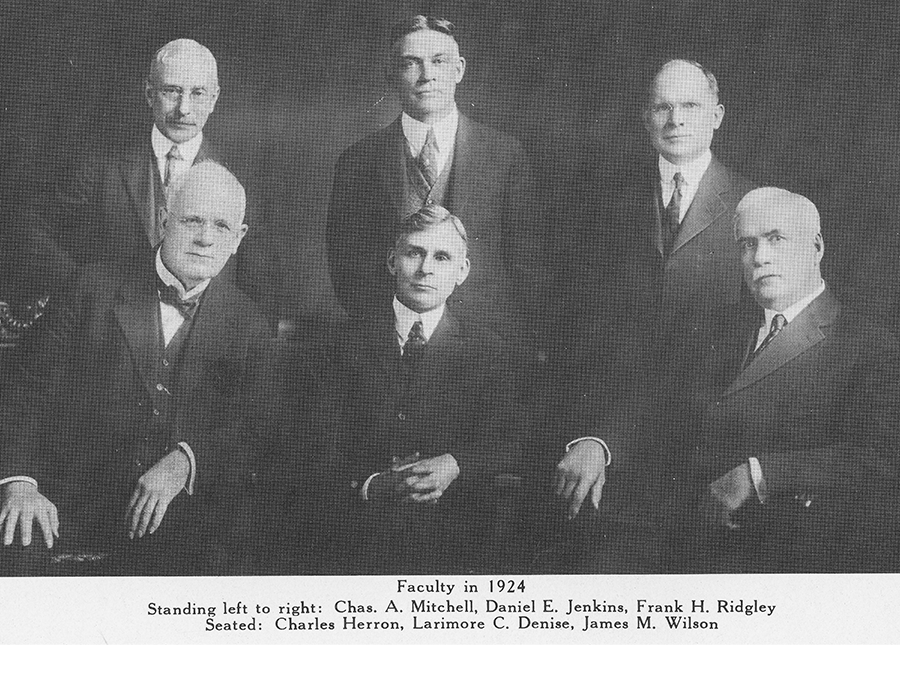
It opened with six students in September 1891, followed by more than a thousand others who prepared and graduated over the next 52 years. Many of these ordained ministers served in rural Midwest churches, an answered prayer for congregations struggling to attract and retain ordained leadership.
Despite this, by 1943 the impact of World War II on seminaries nationwide forced the General Assembly to vote to withdraw its endorsement and close the institution.
Closure and investment
The closure of Presbyterian Theological Seminary at Omaha and liquidation of assets may have ended its teaching and degree-issuing days, but it did not end the seminary’s work.
A group of prominent leaders who served on the seminary board felt strongly that the institution’s work should continue in some form. They hoped the institution could one day reopen as a degree-granting seminary.
These leaders took the $340,000 from the old seminary assets and, through wise investment and good stewardship, increased those funds to several million dollars. Through their dedication and leadership, the seminary emerged as an even stronger and more effective institution.
Seeds of financial support
In 1953, still known as the Presbyterian Theological Seminary at Omaha, the organization began giving scholarship loans to help theological students from 11 Midwestern states.
The General Assembly and the District Court approved using $5,000 from the investment fund for the program. The Board allocated $800 per student per year—$300 for the student and a $500 grant to the seminary attended. After graduation, if the student served five years in a rural church, the loan was canceled.
This financial aid support eventually evolved into the Apollos Program, though loans were no longer granted. Instead, scholarships were gifted with no reimbursement required.
School for Presbyterian pastors
Soon, the Board recognized the great need for continuing education opportunities for pastors.
In the summer of 1957, the first School for Presbyterian Pastors was held at Omaha University. All expenses were paid for 32 ministers to attend, totaling nearly $11,000.
Enrollment grew quickly in the years that followed. Recognized as one of the most unique examples of continuing education, this School was moved to Hastings College in 1988.

A new direction
From seminary to foundation
In 1983, the organization petitioned to become the Omaha Presbyterian Seminary Foundation and gained approval from the District Court of Nebraska in October 1984.
As a Foundation, the Board was authorized to distribute the income from the trust to fund theological and ecclesiastical education without seeking court approval for each distribution. As the Board expanded its programs and funding, it added new members to balance the number of lay and clergy members and to include women and minority board members.
Expanding financial assistance
In addition to the financial aid program and the School for Pastors, the Foundation began to aid other continuing education events.
These events are sponsored by governing bodies of the Presbyterian Church held within the bounds of the 13-state service areas: Colorado, Iowa, Kansas, Minnesota, Missouri, Montana, Nebraska, North Dakota, Oklahoma, South Dakota, Utah, Wisconsin, and Wyoming.

Creating the Board of Advisors
In 1996, led by Dr. Daniel Nelson, the Board of Directors created a supplemental body called the Board of Advisors, an advisory board made up of both clergy and laypersons that focused on developing new ideas and programs to expand the Foundation’s reach and impact.
Always reforming
Growing into a collaborative
Today, the Board recognizes another growing leadership challenge in the Presbyterian Church.
As many pastors are retiring, church attendance is declining. Combined, these two drivers are leading to rural church closures and a sharp drop in seminary enrollment.

Once again facing a shortage of long-term ministry leaders, congregations are searching for innovative and collaborative solutions to address this ministry shortage.
Thus, we began a new chapter as the Presbyterian Leadership Collaborative.
As a leading voice and supporter of Presbyterian education and training, we’ve turned our efforts to inspiring congregation members to respond to God’s call to a breadth of ministry opportunities. We are also exploring how limited-income congregations can be served through commissioned pastors and how to support the education needs of leaders without a Master of Divinity degree.
Our redefined goals are threefold:
- Increase the opportunities for continuing education for pastors, commissioned pastors, and lay leaders
- Grow the number and size of our scholarships and grants
- Find new ways to help churches of all sizes recruit potential leaders for ministry
Expenses continue to rise for aspiring ministers seeking to complete the seven years of study required to fulfill the academic requirements for ordination in the Presbyterian Church (USA).
A call to ministry can be stymied by more lucrative careers—especially when many who enter ministry will serve churches with limited budgets, making it difficult to pay off student loans, stay out of debt, and plan for retirement.
Through our imaginative approach to programming, grants, and scholarships, we provide the critical support future congregational leaders need to take their next steps toward the call God has placed on their hearts.
Source: Hawley, C.A. (1941) Fifty Years on the Nebraska Frontier: History of the Presbyterian Theological Seminary at Omaha, Church History. 10(4) December. pp. 384-38.